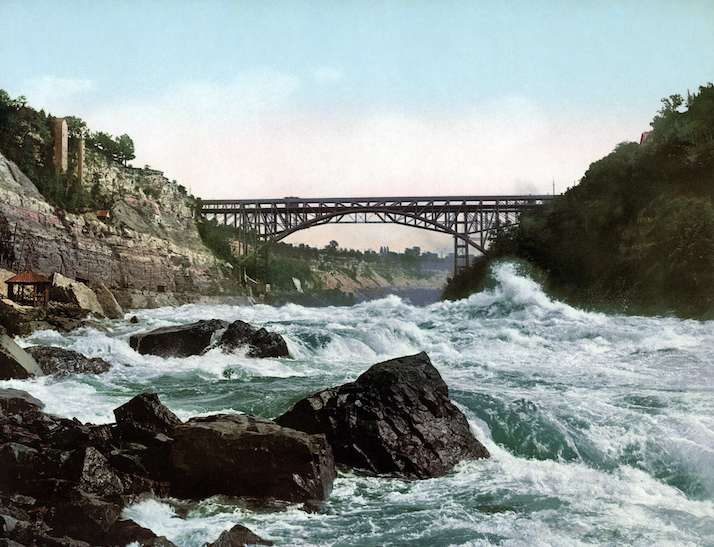
THE BRIDGES THAT BUILT NIAGARA FALLS: IT STARTED WITH A KITE
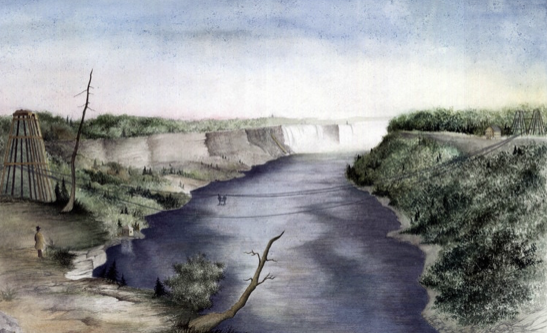
Watercolor reproduction by Donna Marie Campbell, created in 1976 from an original 1848 image in the collection of the Buffalo History Museum.
Most people come to Niagara Falls to see the water.
But for nearly 200 years, some of the most remarkable engineering achievements in North America were the bridges that crossed the Niagara Gorge.
And it all started with a kite.
In the 1840s, the United States and Canada wanted a direct connection across the Niagara River. There was just one problem: the gorge was nearly 800 feet wide, more than 200 feet deep, and the currents below were too dangerous to carry cables across by boat.
Engineers considered every option. The standard method for building a suspension bridge required getting a line across the gorge first. But nobody could shoot an arrow that far.
Then Theodore G. Hulett, an ironworker and supervisor on the project, came up with a simple idea: hold a kite-flying contest.
The prize was $5.
A 16-year-old boy named Homan Walsh took up the challenge. In January 1848, after several attempts, he successfully flew a kite across the gorge. The kite string became the first line connecting the two sides. That string was used to pull a rope, the rope pulled a larger rope, and eventually massive cables stretched across the river.
From that tiny strand of kite string came one of the greatest engineering achievements of the nineteenth century.
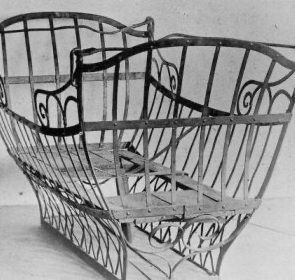
Theodore Hulett’s innovative transport basket served as a temporary link across the gorge and helped make construction of the first Niagara suspension bridge possible.
While the bridge was under construction, Hulett designed an iron basket suspended from the cables that carried workers, tools, and supplies back and forth across the gorge. Soon tourists were paying to ride it. Later, a narrow footbridge only three feet wide was built between the towers. The fares helped finance construction.
On August 1, 1848, the first suspension bridge across the Niagara Gorge officially opened.
Seven years later, it became the foundation for an even more ambitious structure. Engineer John Roebling built a larger two-level bridge on the same site. The lower deck carried pedestrians and horse-drawn vehicles. The upper deck carried railroad trains.
Many thought a locomotive would tear the bridge apart.
To prove them wrong, Roebling personally sent a 23-ton steam engine across the span. The bridge held.
Over the decades, Niagara Falls became home to a series of extraordinary crossings: the Suspension Bridge, the Whirlpool Rapids Bridge, the Honeymoon Bridge, the Michigan Central Railway Bridge, and others that connected two nations through commerce, tourism, and engineering innovation.
One of the most dramatic chapters came in January 1938, when an enormous ice jam destroyed the Honeymoon Bridge. The bridge collapsed onto the frozen river below, creating one of the most famous images in Niagara Falls history.
Today, millions of people cross the river every year without realizing they are following a path first made possible by a teenager, a kite, a length of string, and a group of dreamers who believed they could span one of the most powerful rivers on Earth.
The story of Niagara Falls is not just the story of water. It is also the story of the bridges that conquered the gorge. History is everywhere in Niagara Falls—if we take the time to look for it.
#NiagaraFalls #History #NiagaraRiver #Bridges #HoneymoonBridge #WhirlpoolBridge #LewistonQueenstonBridge #GoNiagaraTours #WesternNewYork #NiagaraCounty #EngineeringHistory #LocalHistory